
The development of lighting technology can be divided into three main stages:
The first stage: lasted from the beginning until 1900 and was characterized by “lighting for light” and efforts to find natural light sources to dispel darkness.
The second stage: Around the middle of the 20th century, after the carbon filament was replaced by a tungsten filament, billions of incandescent lamps were produced every year. The concern during this stage was to increase the illuminance of the light source, not the quality of the light.
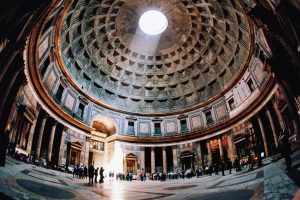
The ancient Pantheon temple is designed to take advantage of natural lighting sources.
The 5 main lighting technologies in human history in this second stage include:
– Fire (fossil fuels and fossil-based)
– Incandescence
– Electric discharge, fluorescent
– Solid state lighting, LED (Solid state led) with 3 development charts of 3 types of LEDs: red (R), green (G), blue (B) and finally white light. The horizontal axis is Timeline, the vertical axis is Luminous efficiency (lumen/w).
The appearance of high-power electric discharge light sources and fluorescents marked a new step forward in lighting technology. In about 90 years (from 1900 to 1990), many different electric light sources were produced using different modern technologies. This second stage can be called the spectral lighting stage, which means that manufacturers and consumers are interested not only in the luminous intensity but also in the photometric characteristics of the light source.

The history of lighting
The third stage: from 1990 to present, lighting technology has gradually shifted to high-benefit lighting technology, characterized by continued improvement of energy-efficient lighting sources, improving the quality of light, saving energy and protecting the environment.
In the beginning, there was only darkness and cold, no sun, no light, no earth, no light, only empty space. A giant cloud of gas and dust was formed. Eventually, that cloud of gas and dust contracted and rolled into a round molten mass and became our sun.
At first, the sun was a bright molten mass. The pressure in the core of the mass increased, causing the temperature to rise to millions of degrees – and stars were born. Due to the process of thermonuclear fusion, the sun began to shine.
In ancient times, prehistoric people used primitive lamps to light their caves. These lamps were made from readily available materials such as stone, tree bark, animal horns filled with fat and a wick. Usually animal and vegetable fats were used.
In the ancient civilizations of Babylon and Egypt, light was a luxury. The legendary Arabian nights were far different from the brilliant urban nights of today. The palaces of the wealthy were lit only by flickering oil lamps. They were usually shaped like bowls with a mouth or spout containing a wick. Animal fat, fish oil or vegetable oil (palm or olive) was the fuel.
In 1809, Humphrey Davy first demonstrated the carbon arc lamp at the Royal Institution in London.

Carbon arc lamp
In 1877, arc lamps were hung outside the Paris Ballet. It was the time of gas-powered horse-drawn carriages and the American Civil War had just over ten years passed. For many, the arc lamp was the first electrical device they had ever seen.
In January 1879, in his laboratory in Menlo Park, New Jersey, Thomas Alva Edison – one of the most famous inventors of all time – created the first incandescent electric light bulb.
Research on low-pressure sodium lamps began in the 1920s. The first commercial applications were used to light the Beek and Geleen avenues in the north of the Netherlands on July 1, 1932. That same year, Purley Way in London was also lit with these lamps. Low-pressure sodium lamps are easily recognizable by their amber-yellow light.
Fluorescent lamps were demonstrated to the public at the New York World’s Fair in 1937. They were commercialized around 1938.

Thomas Edison
The tungsten filament incandescent lamp with halogen vapour was invented in 1957 and introduced in 1960 initially for stage lighting in theatres.
The metal halide lamp was developed around 1960. The metal halide lamp is a type of discharge lamp in a high-pressure mercury vapour environment with the vapour of halogen elements added.
The high-pressure sodium vapour lamp has been widely used since its introduction in 1966. It provides greater illuminance than mercury, fluorescent or incandescent lamps and has a more natural colour than low-pressure sodium lamps.
One of the latest and most notable developments in light source technology is the Fusion Lighting Company (USA) with the help of the US Energy Commission, which is the electrodeless induction lamp using sulfur vapor environment created in 1994.
Currently, LEDs are applied everywhere, from flashlights, bicycle flashing lights, car lights to giant TV screens hanging on buildings in the city. LEDs can be made small, consume less energy, have high luminous efficiency and long life. LEDs are 10 times more efficient than incandescent lamps and have a life span of about 100,000 hours compared to 1000 hours for incandescent lamps.
Source: Internet


